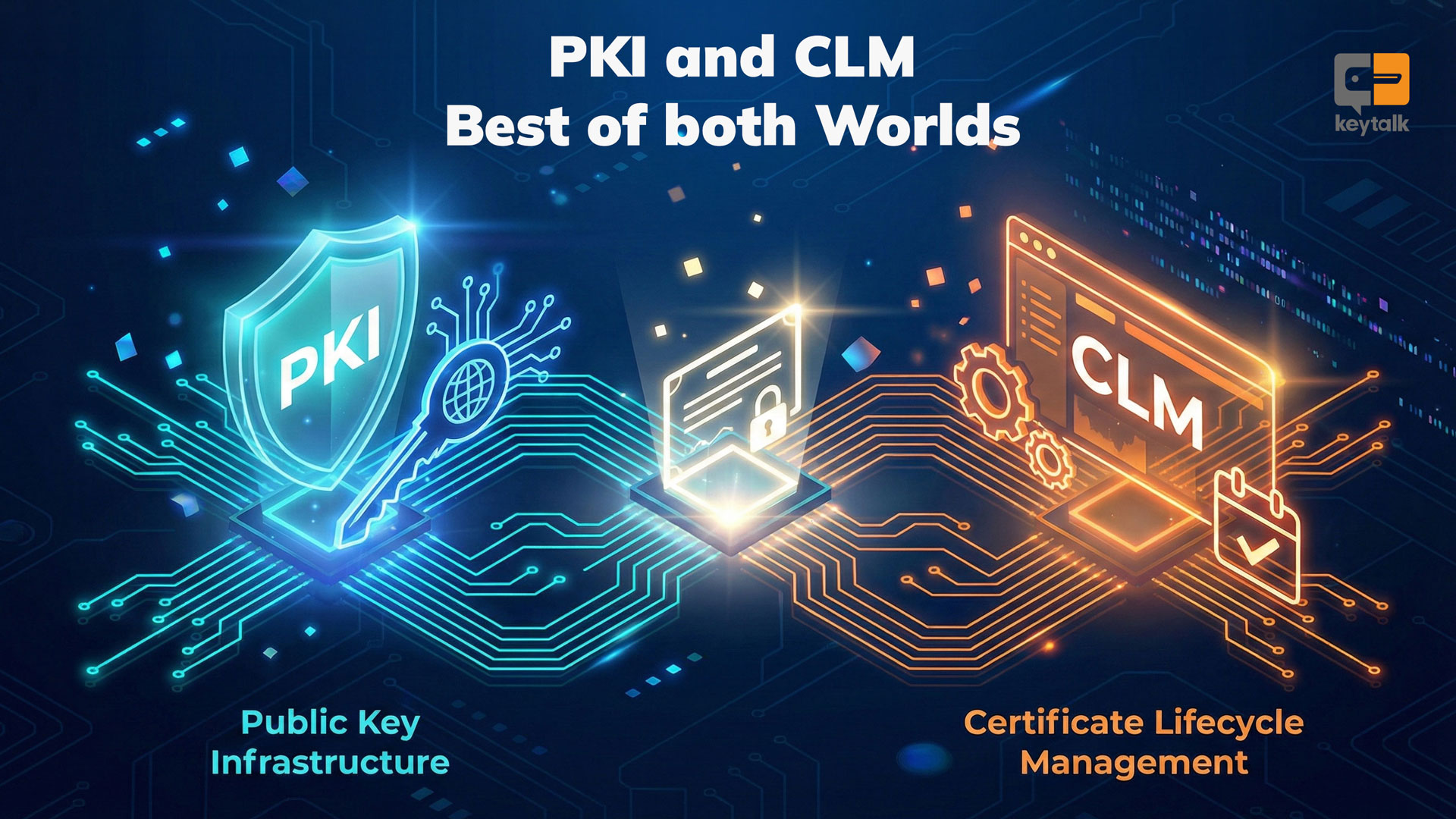
In the world of digital security, the terms PKI and CLM are often used referring to the goal of administrating digital certificates. However, look a little closer, and you’ll find they serve distinct purposes, addressing different business needs and use cases. Understanding the nuance between them is the first step toward a secure, resilient infrastructure.
In this post, we’ll explore what each framework does, why they matter, and how they complement each other to create a seamless security environment.
Public Key Infrastructure (PKI) is the foundational framework of technologies, policies, and roles used to create, manage, distribute, and revoke digital certificates. It’s the “trust engine” that allows people, devices, and services to securely identify each other and encrypt data over a network.
Basic idea
PKI is built on asymmetric cryptography. Every entity has a keypair: a private key kept secret and a public key that can be shared. PKI’s job is to bind a verified identity (a person, website, or device) to a specific public key using a digital certificate. This ensures that when you communicate, you know exactly who is on the other end.
Main components
What PKI is used for
PKI protects everything from standard web browsing (HTTPS) and VPN/Wi-Fi authentication to secure email (S/MIME), code signing, and document integrity.
Certificate lifecycle management (CLM) is the structured process of handling digital certificates from their initial creation through installation, use, renewal, and finally revocation or retirement. It aims to ensure certificates are always valid, trusted, and properly configured so you avoid outages and security gaps caused by expired, misused, or unknown certificates.
If PKI is the engine, Certificate Lifecycle Management (CLM) is the dashboard and the mechanic.
Its primary goal? Ensuring certificates are always valid and properly configured, helping you avoid the dreaded “expired certificate” outages or security gaps.
The Stages of CLM
Typical certificate lifecycle management covers these stages:
Why it matters
Manual management is a recipe for disaster. CLM prevents service disruptions, improves security by enforcing consistent standards, and simplifies compliance with regulations like GDPR, HIPAA, or PCI DSS.
In practice, organizations often use a dedicated certificate management platform that discovers certificates across the network, centralizes visibility, and automates renewals and policy enforcement to keep PKI-based trust working reliably.
PKI and CLM focus on different layers of the same ecosystem: PKI provides the trust infrastructure, while CLM manages the day‑to‑day life of the certificates that PKI issues.
Think of PKI as a library. It contains the books (certificates), the rules for using them, and the authority that makes those books meaningful.
CLM is the librarian and the digital catalog. It keeps track of where every book is, ensures they are returned (or renewed) before the due date, and makes sure no outdated or damaged books stay on the shelves. One cannot function efficiently at scale without the other.
How they differ
It is established that PKI and CLM complement each other. But is it possible to implement PKI without dedicated CLM tools? Yes it is possible and in some cases one can manage certificates without a full private PKI, though the latter is more limited.
PKI without CLM
Companies often run PKI (e.g., their own internal CA like Microsoft CA) with manual or basic processes for certificate handling instead of automated CLM.
CLM without (private) PKI
CLM tools can manage certificates issued by public CAs (like Let’s Encrypt) or third-party providers without running your own PKI infrastructure.
Key relationship
PKI provides the certificates (via CAs); CLM automates their operational lifecycle. Most enterprises use both for scale, but each can stand alone depending on needs and size.
Most organizations struggle because they have a PKI but lack the tools to manage it—or they have a management tool that doesn’t integrate well with their CA.
KeyTalk CKMS bridges this gap. It is a complete system that integrates both PKI and CLM within a single, unified platform.
Whether you need PKI and CLM or just one of them, the KeyTalk CKMS is able to fulfill business needs as required.
Managing certificates doesn’t have to be a manual burden. Reach out to the KeyTalk team today for a deep dive into your specific use case. Let’s make your certificate management invisible, automated, and secure.
Reach out to us today. You can contact us by e-mail or through our contact page.